Chicken Katsu with Homemade Katsu Sauce
Chicken katsu made with panko-crusted cutlets fried golden and served over rice with a quick homemade katsu sauce. Ready in 35 minutes.
This post may contain affiliate links. See our disclosure policy.
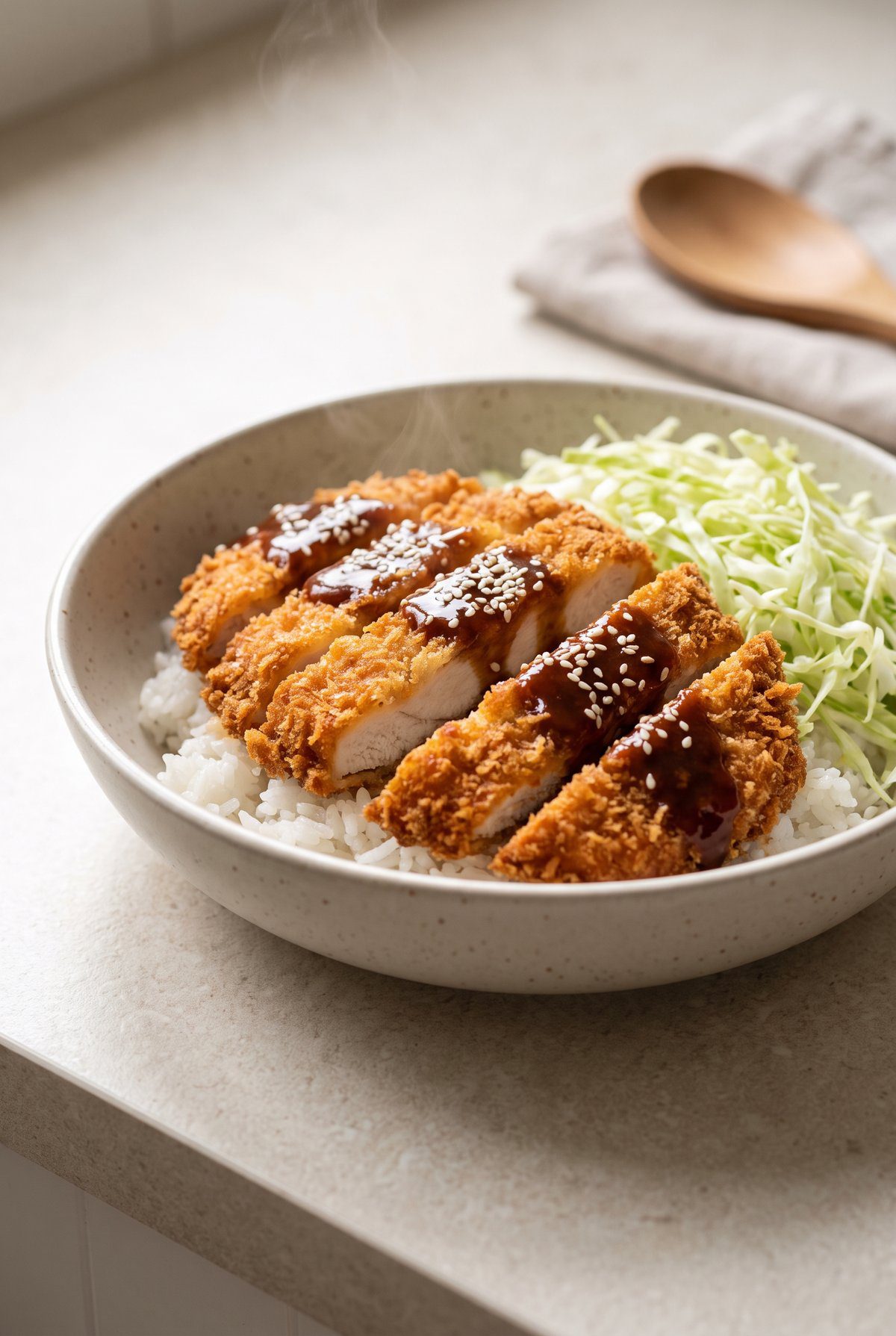
Chicken katsu is a panko-crusted chicken cutlet fried until the coating shatters under the knife, sliced into strips and served over rice with a sweet-savory brown sauce. It’s the Japanese dinner my kids ask for by name, and it takes about 35 minutes from the cutting board to the table.
Panko is doing the heavy lifting. Regular breadcrumbs are ground fine, so they pack tight and soak up oil until the crust goes dense and greasy. Panko flakes are big and airy, and they fry into the shaggy, crackly coating katsu is known for. Buy the bag that says panko on the front and don’t substitute.
The sauce takes about a minute. Ketchup, Worcestershire, oyster sauce and a little brown sugar whisked together is a close cousin to the bottled tonkatsu sauce sold in Japanese markets, and it’s better than anything you’d get on a plate at home otherwise. Make it first so it has time to sit while you fry.
Why You’ll Love This Chicken Katsu Recipe
- A crust that actually crunches. Panko fries into big crisp flakes instead of the tight, oily shell regular breadcrumbs give you.
- Thirty-five minutes, most of it prep. Half-inch cutlets need about 6 minutes in the oil, so the frying is the fastest part of the night.
- Two picky-eater problems solved at once. It’s a chicken tender with a real dish name, and the sauce goes on the side so nobody has to touch it.
- The sauce is four pantry ingredients. Ketchup, Worcestershire, oyster sauce and brown sugar, whisked in a bowl, no cooking required.
Chicken Katsu Ingredients
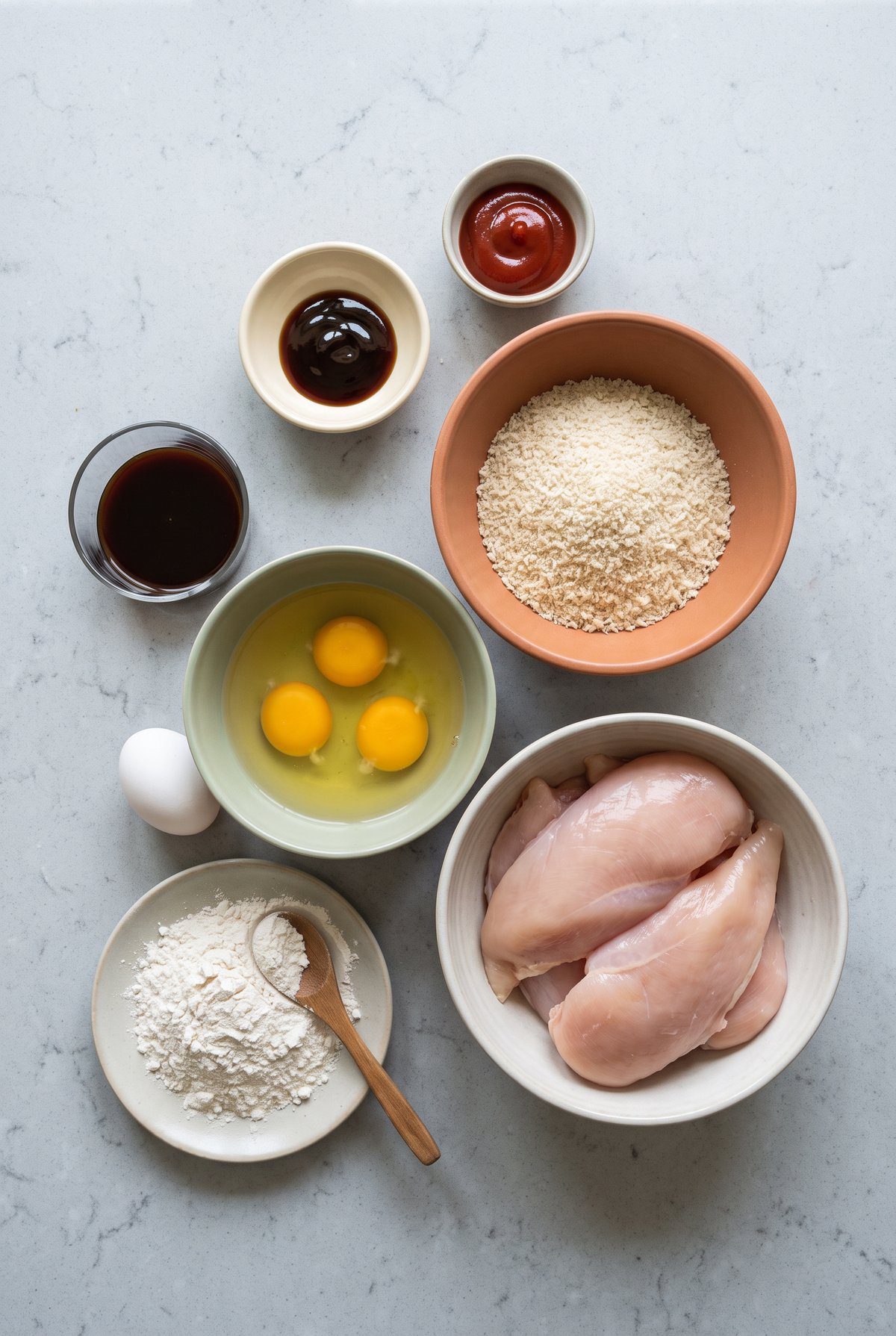
Cut the chicken breasts in half horizontally before pounding them. Starting from a 1-inch breast and beating it down to 1/2 inch tears the meat and leaves you with ragged edges, while halving first means you barely have to pound at all. Even thickness is what gets the whole cutlet to 165°F at the same moment.
- 2 large boneless, skinless chicken breasts (about 1 1/2 lbs), halved horizontally into 4 cutlets
- 1 tsp salt
- 1/2 tsp black pepper
- 1/2 cup all-purpose flour
- 2 large eggs, beaten
- 2 cups panko breadcrumbs
- 3 cups vegetable oil, for frying
- 1/3 cup ketchup
- 1/4 cup Worcestershire sauce
- 2 tbsp oyster sauce
- 1 1/2 tbsp brown sugar
- 3 cups cooked white rice, for serving
- 2 cups finely shredded green cabbage, for serving
- 1 tsp toasted sesame seeds, for garnish
Recipe Variations
- Use boneless, skinless chicken thighs pounded to 1/2 inch. They stay juicier than breast and take about the same time in the oil, and they still need to reach an internal temperature of 165°F.
- Make tonkatsu, the pork version this dish is named after, with 1/2-inch boneless pork loin cutlets. Bread and fry them the same way, cook to 145°F, and let them rest 3 minutes before slicing.
- Bake instead of frying. Set the breaded cutlets on a wire rack over a sheet pan, spray both sides with oil, and bake at 400°F for 25-30 minutes without flipping, until the panko is golden and the chicken reaches 165°F.
How to Make Chicken Katsu
- Whisk the katsu sauce: Stir the ketchup, Worcestershire sauce, oyster sauce, and brown sugar together in a small bowl until the sugar dissolves. Set it aside. It thickens a little as it sits and tastes better after 10 minutes.
- Make even cutlets: Lay each chicken breast flat and slice it in half horizontally to make 4 thin pieces. Put them between two sheets of plastic wrap and pound the thick spots down until each cutlet is an even 1/2 inch. Pat them dry and season both sides with the salt and pepper.
- Set up the breading station: Line up three shallow dishes: the flour in the first, the beaten eggs in the second, and the panko in the third.
- Bread the cutlets: Coat a cutlet in flour and shake off the excess, dip it in egg and let the extra drip away, then lay it in the panko and press firmly on both sides until there are no bare patches. Set the breaded cutlets on a plate and let them sit 5 minutes so the coating grabs hold.
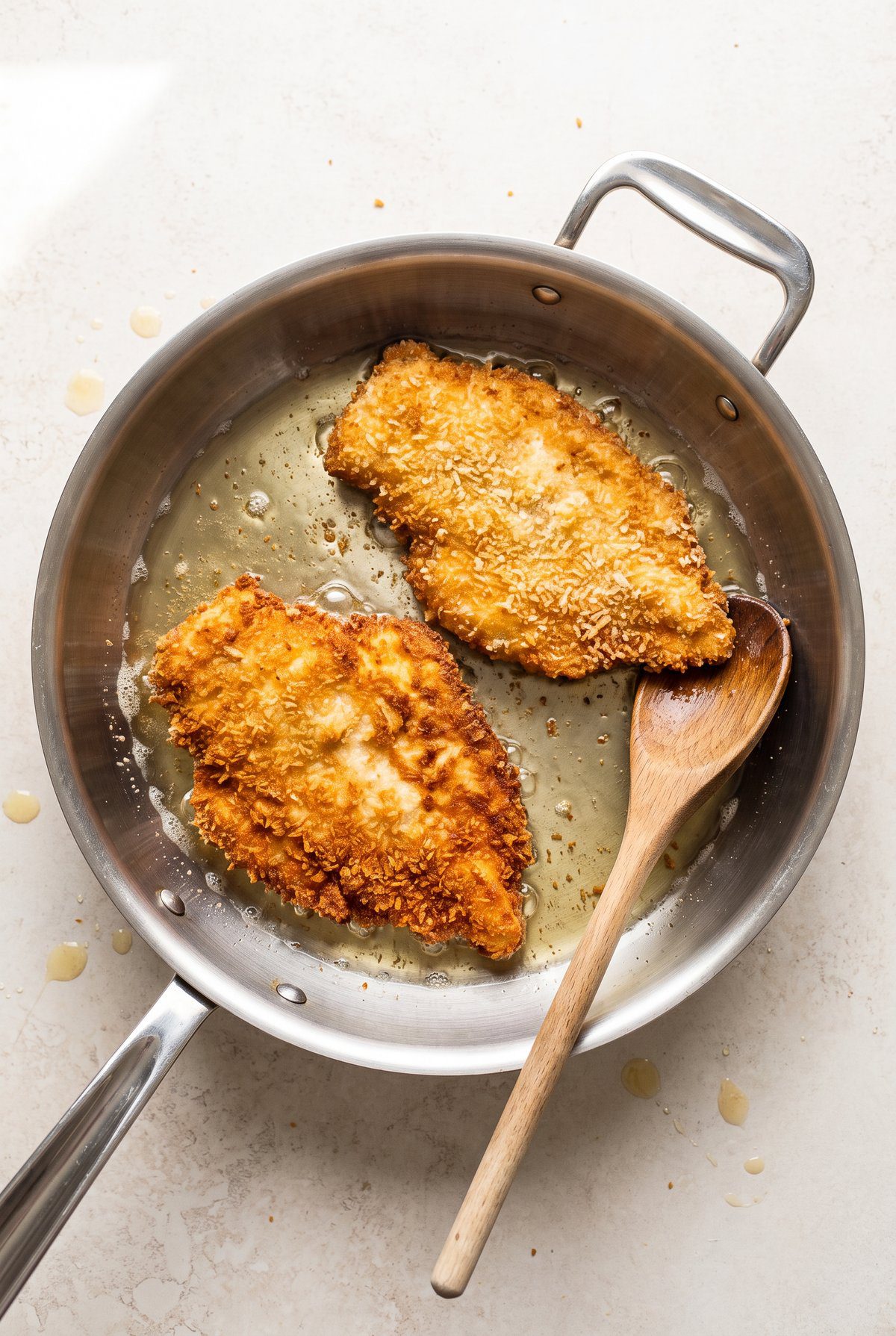
- Heat the oil: Pour the oil into a 10-inch heavy skillet to a depth of about 1/2 inch, which takes roughly the full 3 cups, and heat over medium until it reaches 340-350°F. A few panko crumbs dropped in should sizzle steadily right away without browning instantly.
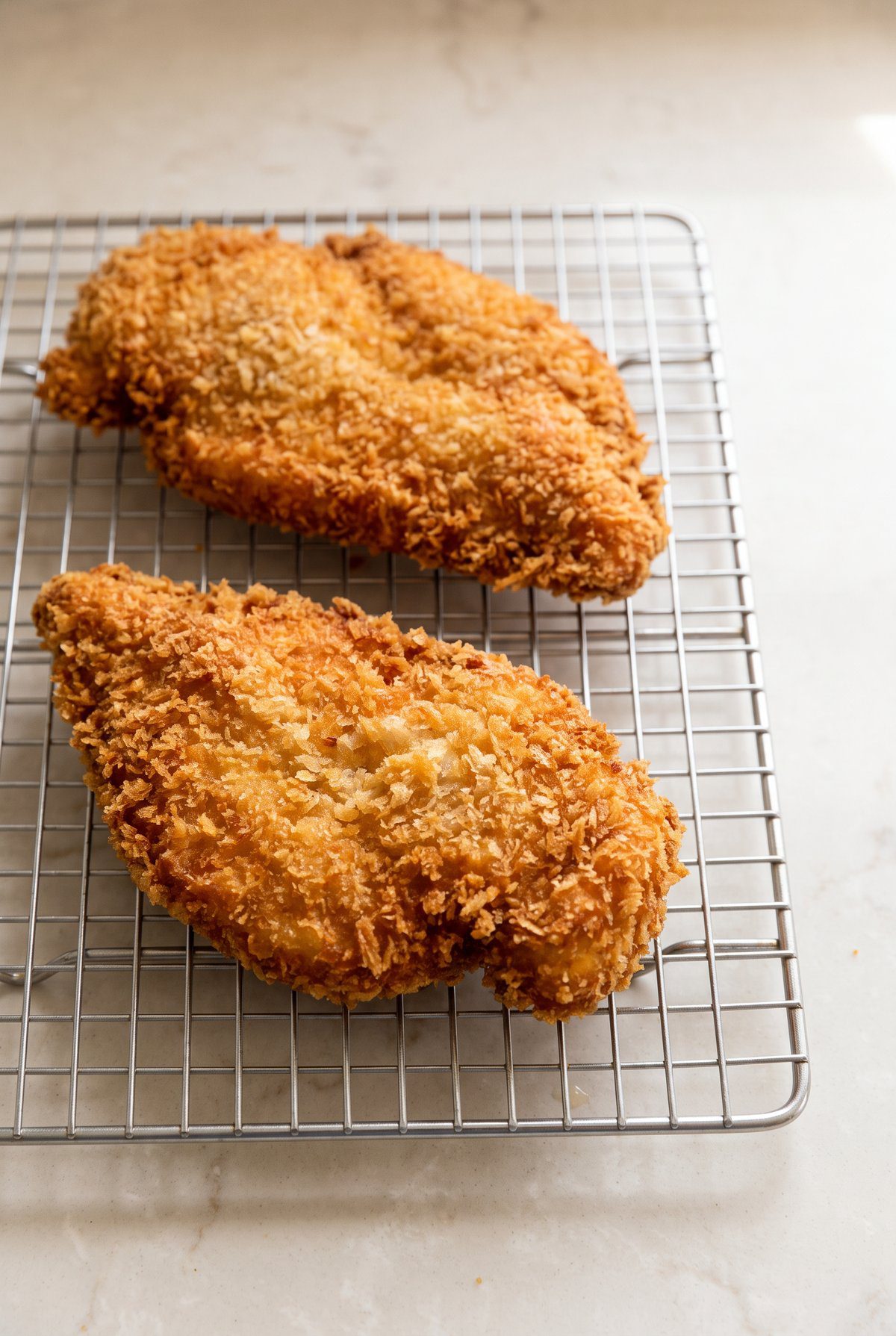
- Fry: Fry 2 cutlets at a time for about 3 minutes per side, until the crust is deep golden and the thickest part reads 165°F on a thermometer. Thinner cutlets get there in closer to 2 minutes a side, so check early. Drain on a wire rack, not paper towels, and let the oil come back up to temperature before the next batch.
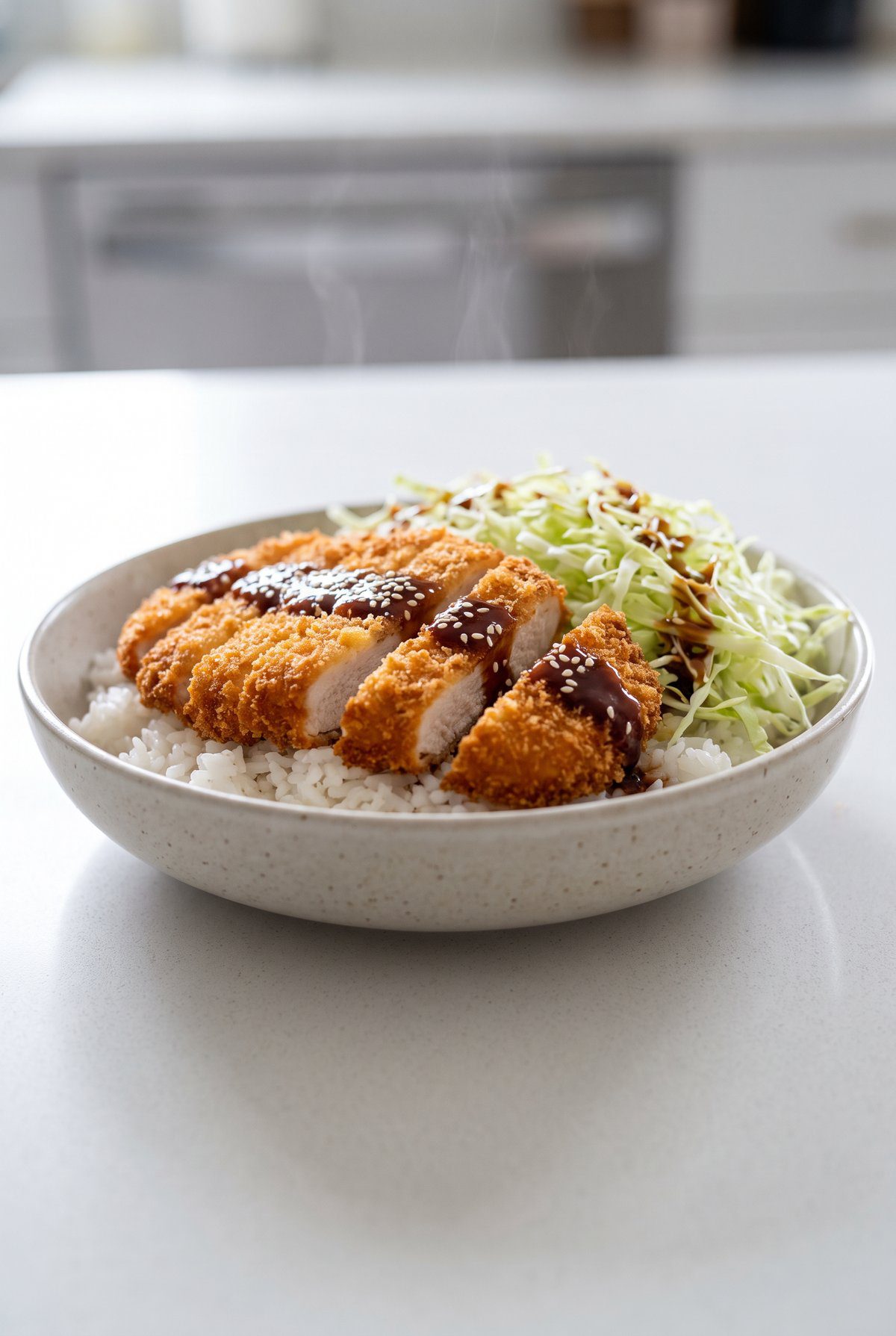
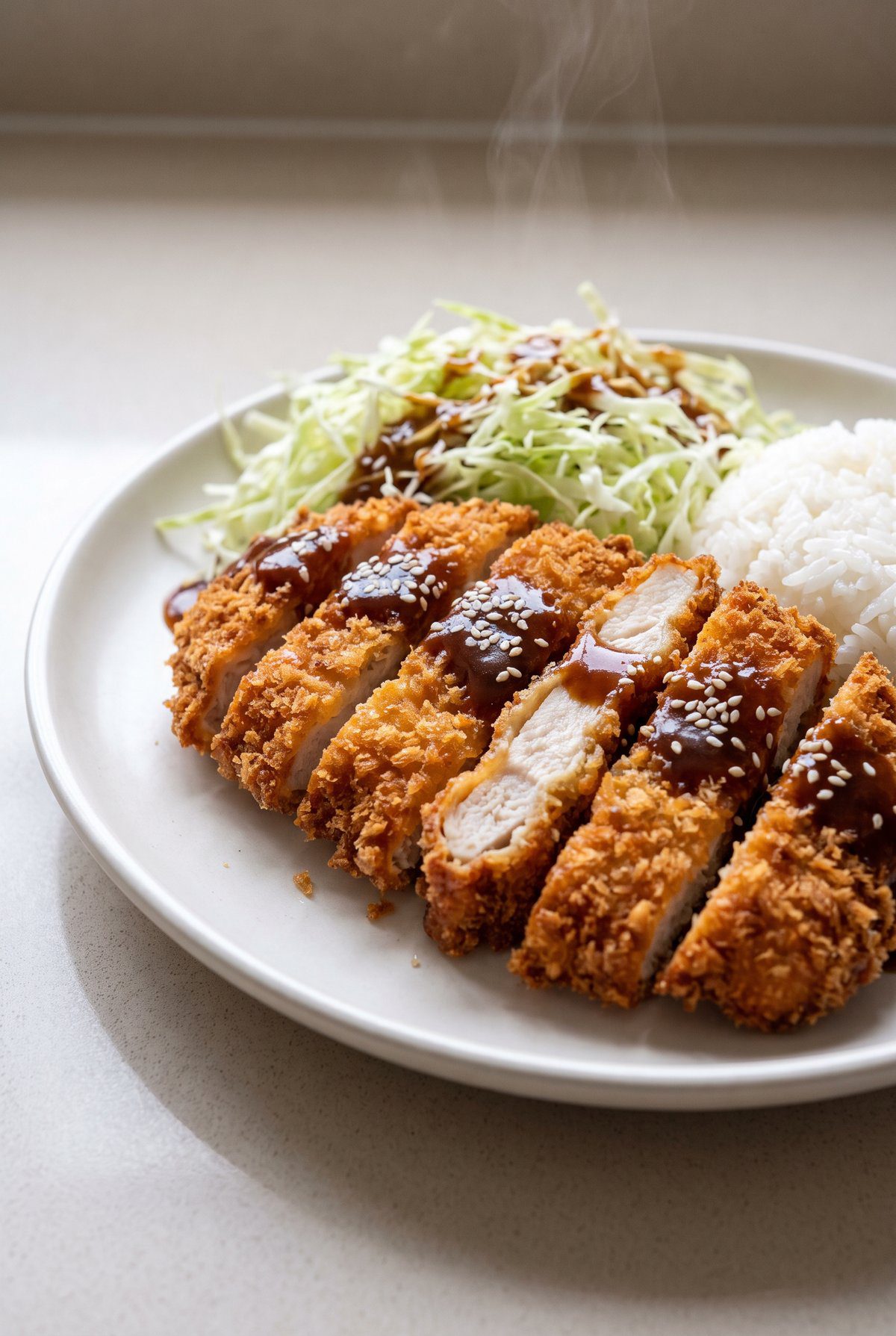
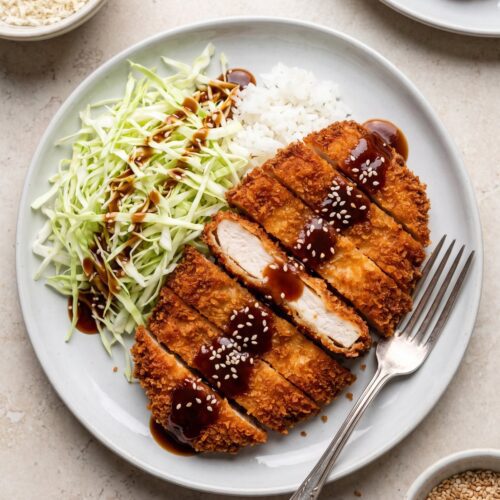
- Slice and serve: Rest the cutlets 3 minutes, then cut them crosswise into 1-inch strips. Serve over the cooked rice with a pile of shredded cabbage alongside, the katsu sauce spooned over or served on the side, and the sesame seeds scattered on top.
Recipe FAQs
What Is the Sauce on Chicken Katsu?
It’s katsu sauce, also sold as tonkatsu sauce. It’s a thick, tangy brown sauce built on ketchup and Worcestershire, sweeter than steak sauce and less sharp than barbecue. Bottled Bull-Dog brand is the standard, and the four-ingredient version here is very close.
Why Does My Panko Coating Fall Off?
Two usual causes. The chicken was wet when it hit the flour, or the breaded cutlets went straight into the oil. Pat the meat dry, press the panko on hard, and give the coated cutlets 5 minutes on the counter before frying.
How Much Oil Do I Need to Fry Chicken Katsu?
About 1/2 inch in the pan, which is roughly 3 cups in a 10-inch skillet. That’s shallow frying, and it’s enough to crisp both sides with one flip. Deep frying works too but uses two or three times the oil for the same result.
Can I Make It in an Air Fryer?
Yes. Spray the breaded cutlets on both sides with oil and cook at 380°F for 12-14 minutes, flipping halfway, until the chicken reaches 165°F. The crust comes out drier and paler than fried, so be generous with the oil spray.
What’s the Difference Between Katsu and Tonkatsu?
The protein. Tonkatsu is the original pork cutlet, and chicken katsu is the chicken version. Same breading, same frying, same sauce. Pork cooks to 145°F with a 3-minute rest; chicken goes to 165°F.
Cooking Tips
- Keep one hand for the dry dishes and one for the egg. Two wet hands turn into breaded mittens somewhere around the second cutlet.
- Clip a thermometer to the pan if you have one. Oil that drifts below 325°F soaks into the panko instead of crisping it, and above 375°F the crust browns long before the center hits 165°F.
- Salt the cutlets right after they come out of the oil, even though they were seasoned before breading. Salt hitting a hot crust sticks and reads on the tongue in a way that under-crust salt never quite does.
Storage and Freezing
To store: Refrigerate the fried cutlets in an airtight container for up to 3 days. Store the sauce separately in a jar, where it keeps 2 weeks.
To freeze: Freeze the fried cutlets flat on a sheet pan, then bag them for up to 2 months. Reheat from frozen at 400°F for 15-18 minutes, until the crust re-crisps and the center reaches 165°F.
To reheat: Warm refrigerated cutlets on a wire rack at 375°F for 8-10 minutes or in an air fryer at 350°F for 5 minutes, until heated to 165°F. The microwave works and turns the crust to cardboard, so use it only if you have to.
How to Serve Chicken Katsu
Chicken Katsu is traditionally plated with steamed white rice and a mound of very finely shredded raw cabbage, which cuts the richness better than any cooked vegetable would. A bowl of miso soup on the side makes it feel like a full Japanese dinner. Leftover strips are also the base for katsu curry, laid over rice and covered in Japanese curry sauce.
Loved This Recipe?
Chicken Katsu turns four chicken cutlets and a bag of panko into a dinner that clears plates in 35 minutes.
Leave a star rating in the comments below, it helps other people find this recipe. Made it? Tag @allwellfed on Instagram, I love seeing this one in other people’s kitchens.
Chicken Katsu with Homemade Katsu Sauce
Equipment
- Instant-Read Thermometer 165°F in the thickest part, checked in two spots. Color is not a reliable read.
Ingredients
- 2 large boneless, skinless chicken breasts about 1 1/2 lbs, halved horizontally into 4 cutlets
- 1 tsp salt
- 1/2 tsp black pepper
- 1/2 cup all-purpose flour
- 2 large eggs beaten
- 2 cups panko breadcrumbs
- 3 cups vegetable oil for frying
- 1/3 cup ketchup
- 1/4 cup Worcestershire sauce
- 2 tbsp oyster sauce
- 1 1/2 tbsp brown sugar
- 3 cups cooked white rice for serving
- 2 cups finely shredded green cabbage for serving
- 1 tsp toasted sesame seeds for garnish

Instructions
- Whisk the katsu sauce: Stir the ketchup, Worcestershire sauce, oyster sauce, and brown sugar together in a small bowl until the sugar dissolves. Set it aside. It thickens a little as it sits and tastes better after 10 minutes.
- Make even cutlets: Lay each chicken breast flat and slice it in half horizontally to make 4 thin pieces. Put them between two sheets of plastic wrap and pound the thick spots down until each cutlet is an even 1/2 inch. Pat them dry and season both sides with the salt and pepper.
- Set up the breading station: Line up three shallow dishes: the flour in the first, the beaten eggs in the second, and the panko in the third.
- Bread the cutlets: Coat a cutlet in flour and shake off the excess, dip it in egg and let the extra drip away, then lay it in the panko and press firmly on both sides until there are no bare patches. Set the breaded cutlets on a plate and let them sit 5 minutes so the coating grabs hold.
- Heat the oil: Pour the oil into a 10-inch heavy skillet to a depth of about 1/2 inch, which takes roughly the full 3 cups, and heat over medium until it reaches 340-350°F. A few panko crumbs dropped in should sizzle steadily right away without browning instantly.
- Fry: Fry 2 cutlets at a time for about 3 minutes per side, until the crust is deep golden and the thickest part reads 165°F on a thermometer. Thinner cutlets get there in closer to 2 minutes a side, so check early. Drain on a wire rack, not paper towels, and let the oil come back up to temperature before the next batch.
- Slice and serve: Rest the cutlets 3 minutes, then cut them crosswise into 1-inch strips. Serve over the cooked rice with a pile of shredded cabbage alongside, the katsu sauce spooned over or served on the side, and the sesame seeds scattered on top.
Notes

If you made this, leave a star rating down in the comments. It takes about ten seconds, and it’s how other cooks decide whether a recipe is worth trying.