Prime Rib Roast with Garlic Herb Butter
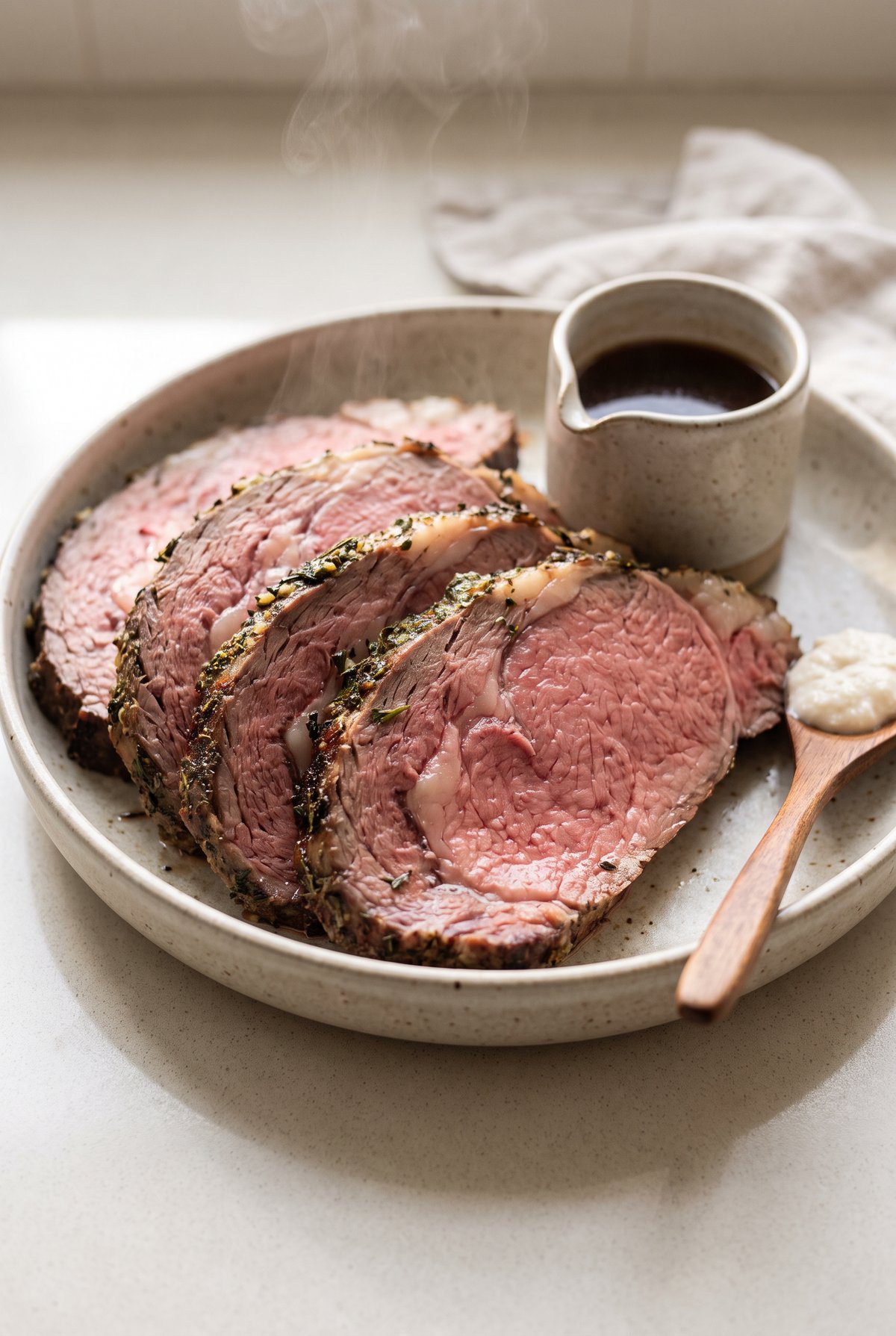
Prime rib roasted with a garlic herb butter crust, seared at 500°F then finished low, and carved after a 30-minute rest. The holiday centerpiece.
This post may contain affiliate links. See our disclosure policy.
Prime rib is the roast people save for Christmas and then get nervous about, which is fair. It’s an expensive piece of beef and there’s no second try. The good news is it’s one of the simpler things you can cook: salt, garlic herb butter, a hot blast, a low oven, and a thermometer.
The two-temperature method is what does the work. Fifteen minutes at 500°F melts the butter into a browned, herby crust, then dropping the oven to 325°F cooks the inside gently enough that you get pink almost to the edge instead of a thick gray band. Minutes per pound gets you in the neighborhood, and the thermometer gets you the rest of the way.
Then leave it alone for 30 minutes. A roast this size keeps cooking on the counter and climbs another 5 to 10 degrees while it sits, which is exactly why you pull it early. Carving it hot sends all that juice onto the board.
Why You’ll Love This Prime Rib Recipe
- A crust worth the price of the roast. Softened butter loaded with garlic, rosemary, and thyme clings to the fat cap and browns into a savory shell in the first 15 minutes.
- Pink almost to the edge. Dropping the oven to 325°F after the sear cooks the interior gently, so you get a thin brown band instead of a wide gray one.
- The thermometer does the thinking. Pull the roast at 125°F and it lands at medium rare after resting, whatever the clock says.
- The drippings become the sauce. Red wine and beef broth deglazed in the roasting pan while the meat rests give you au jus with nothing extra to buy.
Prime Rib Ingredients
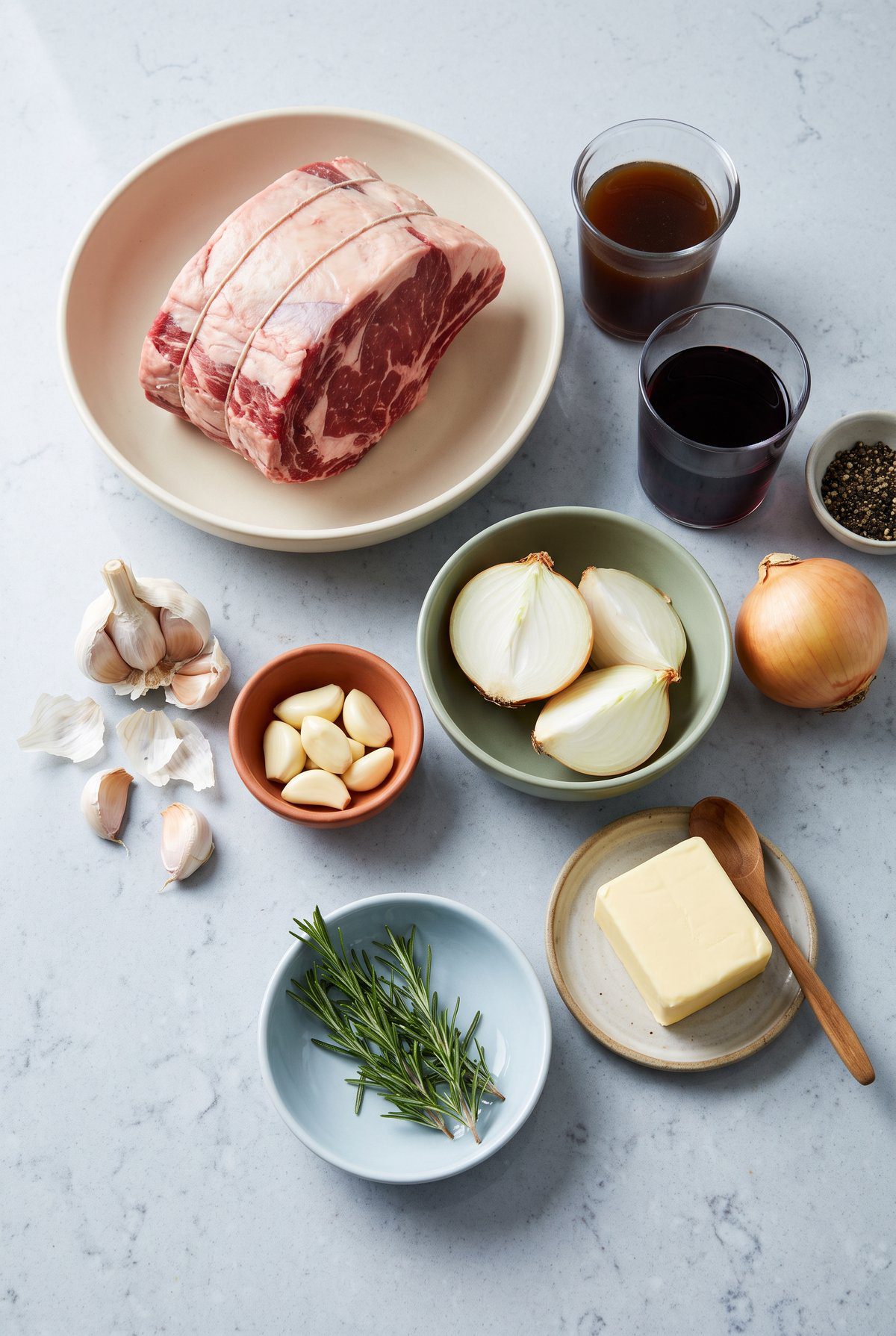
Ask the butcher for a bone-in standing rib roast from the loin end, sometimes called the first cut or the small end. It has one big eye of meat instead of several muscles running through it, so every slice looks the same. Ask them to cut the bones free and tie them back on and carving takes 30 seconds instead of five minutes of sawing.
- 1 (5 lb) bone-in standing rib roast, 2 to 3 bones
- 1 tbsp kosher salt
- 2 tsp black pepper
- 1/2 cup unsalted butter (8 tbsp), softened
- 8 cloves garlic, minced
- 2 tbsp fresh rosemary, chopped
- 1 tbsp fresh thyme leaves, chopped
- 1 large yellow onion, quartered
- 1 cup dry red wine
- 2 cups beef broth
- Prepared horseradish, for serving
Recipe Variations
- Use a boneless rib roast if that’s what the store has. It cooks roughly 2 minutes per pound faster, so start checking the thermometer 15 minutes early, and still pull it at 125°F for medium rare.
- Swap the herb butter for a dry crust of 2 tablespoons coarse salt, 2 tablespoons cracked pepper, and 8 cloves of minced garlic pressed onto the fat cap. It browns harder and gives you a steakhouse-style bark.
- Skip the au jus and serve horseradish cream instead: 1/2 cup sour cream stirred with 3 tablespoons prepared horseradish, 1 tablespoon lemon juice, and a pinch of salt.
How to Make Prime Rib
- Salt it early: Pat the roast dry and rub the kosher salt and black pepper over every surface. Set it on a rack over a sheet pan and refrigerate uncovered for at least 4 hours and up to 24. The salt works its way in, and the dry surface browns far better in the oven.
- Let it come to room temperature: Take the roast out of the fridge 2 hours before it goes in the oven. A cold center means the outside overshoots by 20 degrees waiting for the middle to catch up. This stretch is hands-off and isn’t counted in the times on the card.
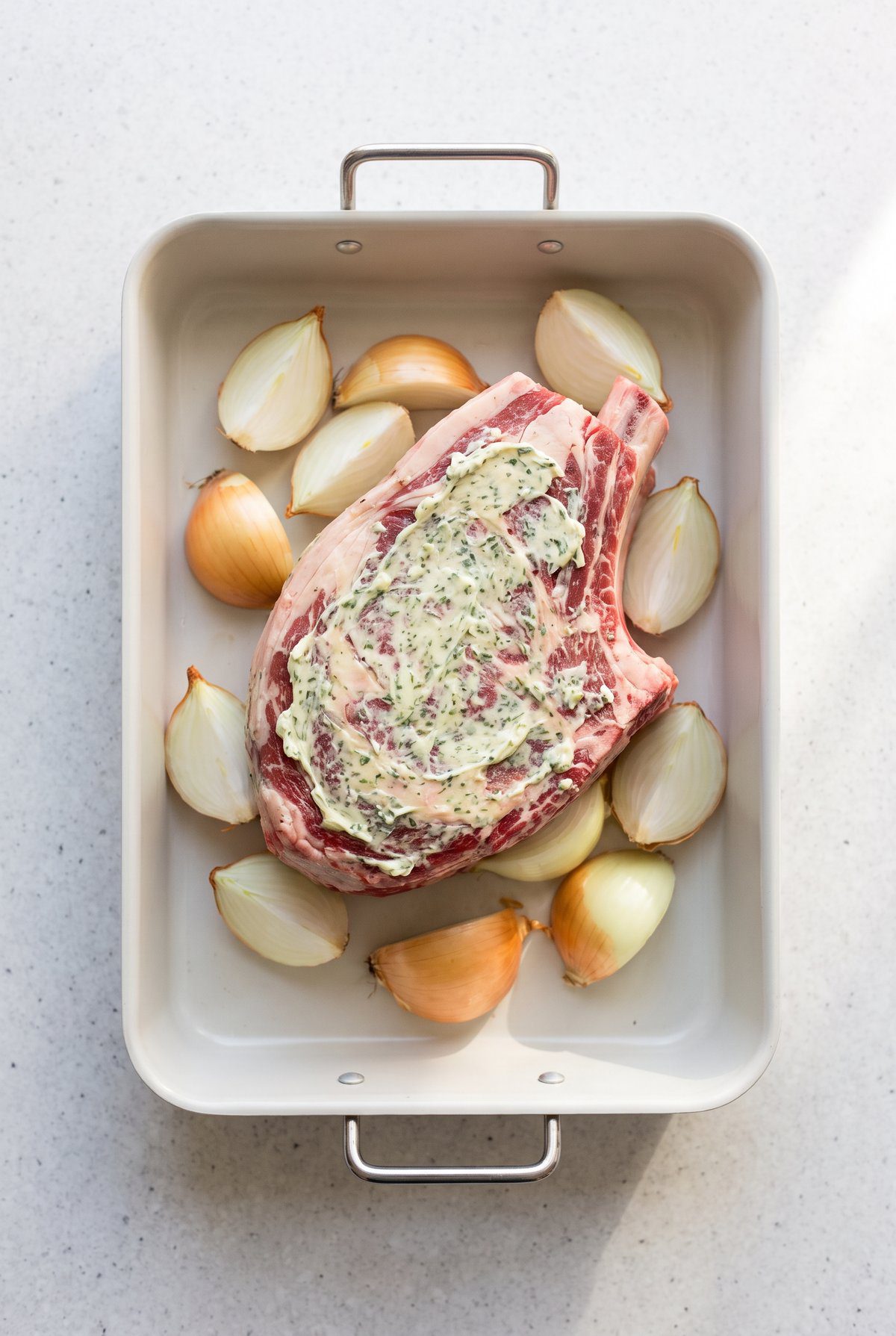
- Make the garlic herb butter: Mash the softened butter with the garlic, rosemary, and thyme in a small bowl until evenly mixed. Spread it thickly over the top and sides of the roast, right over the fat cap.
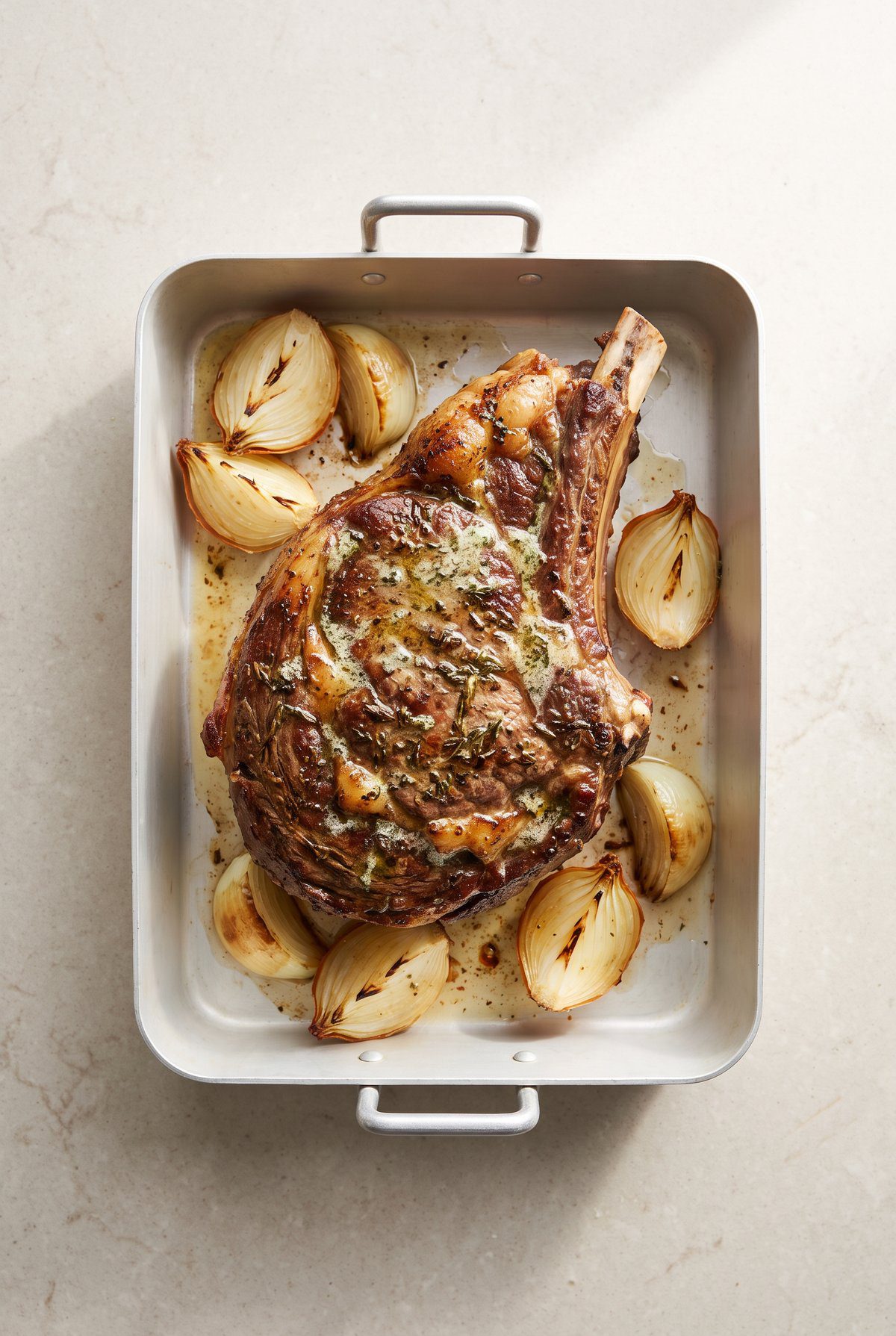
- Blast it hot: Heat the oven to 500°F. Scatter the quartered onion in a roasting pan and set the roast on top, bone side down. Roast 15 minutes, until the butter has melted in and the surface is browned.
- Drop the heat and roast to temperature: Lower the oven to 325°F without leaving the door open any longer than you have to. Roast about 13-15 minutes per pound, roughly 65-75 minutes for a 5-pound roast, until an instant-read thermometer in the center of the meat and clear of the bone reads 125°F for medium rare. Start checking at 60 minutes.
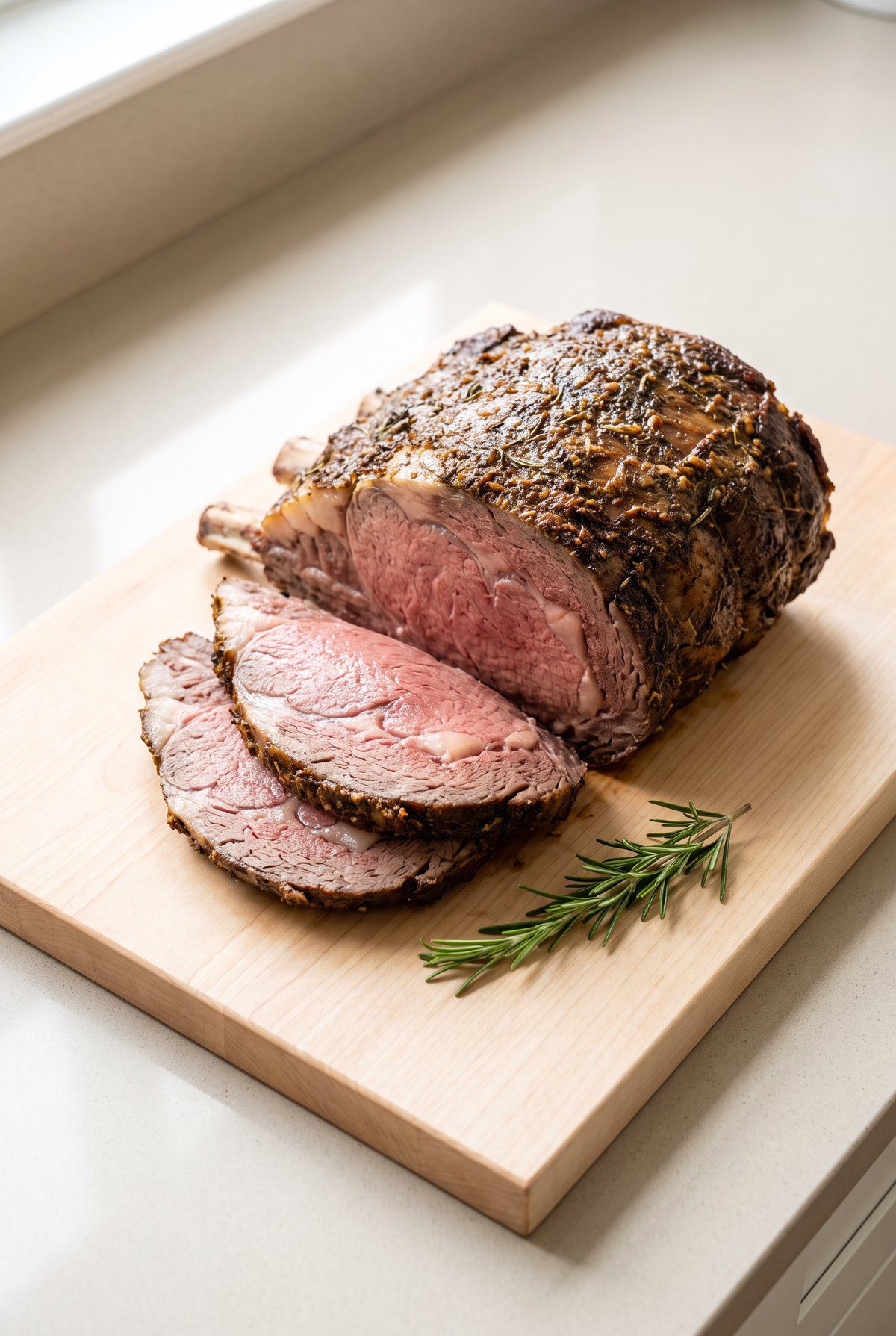
- Rest 30 minutes: Move the roast to a cutting board and tent it loosely with foil. It climbs another 5-10 degrees as it sits, landing at 130-135°F for medium rare. USDA guidance for whole cuts of beef is 145°F followed by a 3-minute rest, so pull the roast at 140°F instead if you want to meet that mark. Either way, the 30 minutes are not optional: carve it early and the juice ends up on the board.
- Make the au jus and carve: Set the roasting pan over medium-high heat on the stove, pour in the red wine, and scrape up the browned bits for 3-4 minutes. Add the beef broth and simmer 5-6 minutes until it reduces slightly, then strain into a pitcher. Cut the bones away in one piece, slice the meat across the grain about 1/2 inch thick, and serve with the jus and horseradish.
Recipe FAQs
How Much Prime Rib Do I Need per Person?
Figure about 10 ounces of bone-in roast per person, so a 5-pound roast serves 8. Bone and fat cap take up a good share of that weight, so it plates smaller than the number sounds. If you want leftovers, and you want leftovers, buy a 7-pound roast and give it the same 13 to 15 minutes per pound.
What Temperature Is Prime Rib Done?
Pull it at 125°F for medium rare, 135°F for medium, and 140°F if you’re following USDA guidance for whole cuts of beef, which lands at 145°F after the rest. It rises 5-10 degrees while resting, so pull before your target rather than at it.
Bone-In or Boneless?
Bone-in. The bones insulate one side and slow the cooking there, which gives you more evenly pink meat, and they act as a rack so the bottom isn’t sitting in drippings. Boneless works and cooks a little faster.
Do I Need to Sear It in a Skillet First?
No. The 15 minutes at 500°F is the sear. Wrestling a 5-pound roast into a skillet fills the kitchen with smoke and doesn’t brown it any better than the oven does.
Can I Cook Prime Rib Ahead of Time?
Not really, and this is the one dish worth building the schedule around. Salt it a day ahead and make the herb butter two days ahead, but roasting it early and holding it warm pushes it past medium rare while it waits.
Cooking Tips
- Buy a leave-in probe thermometer if you plan to cook this more than once. Opening the oven every ten minutes to check drops the temperature and stretches the cook time, and a probe you can read through the door removes the guessing.
- Put the probe in the thickest part of the eye and keep it well clear of the bone. Bone conducts heat differently and reads about 10 degrees higher than the meat around it, which is how a roast gets pulled rare by mistake.
- Carve with a long, thin slicing knife, not a chef’s knife. A chef’s knife is too short to cross a rib roast in one pass, and sawing back and forth tears the slice and squeezes the juice out of it.
Storage and Freezing
To store: Refrigerate leftovers in an airtight container for up to 4 days. Store the slices in a little of the jus so they don’t dry out.
To freeze: Cooked prime rib freezes for up to 2 months, though the texture suffers and it’s a shame to do it to beef this good. Slice it thick, wrap tightly, and thaw overnight in the fridge.
To reheat: FoodSafety.gov says to reheat leftovers to 165°F, and at 165°F prime rib is well done. That’s the honest trade-off. Most people eat it cold in sandwiches instead. If you want it hot, warm the slices in a covered dish with a few tablespoons of jus at 275°F for 10-15 minutes and check that they reach 165°F.
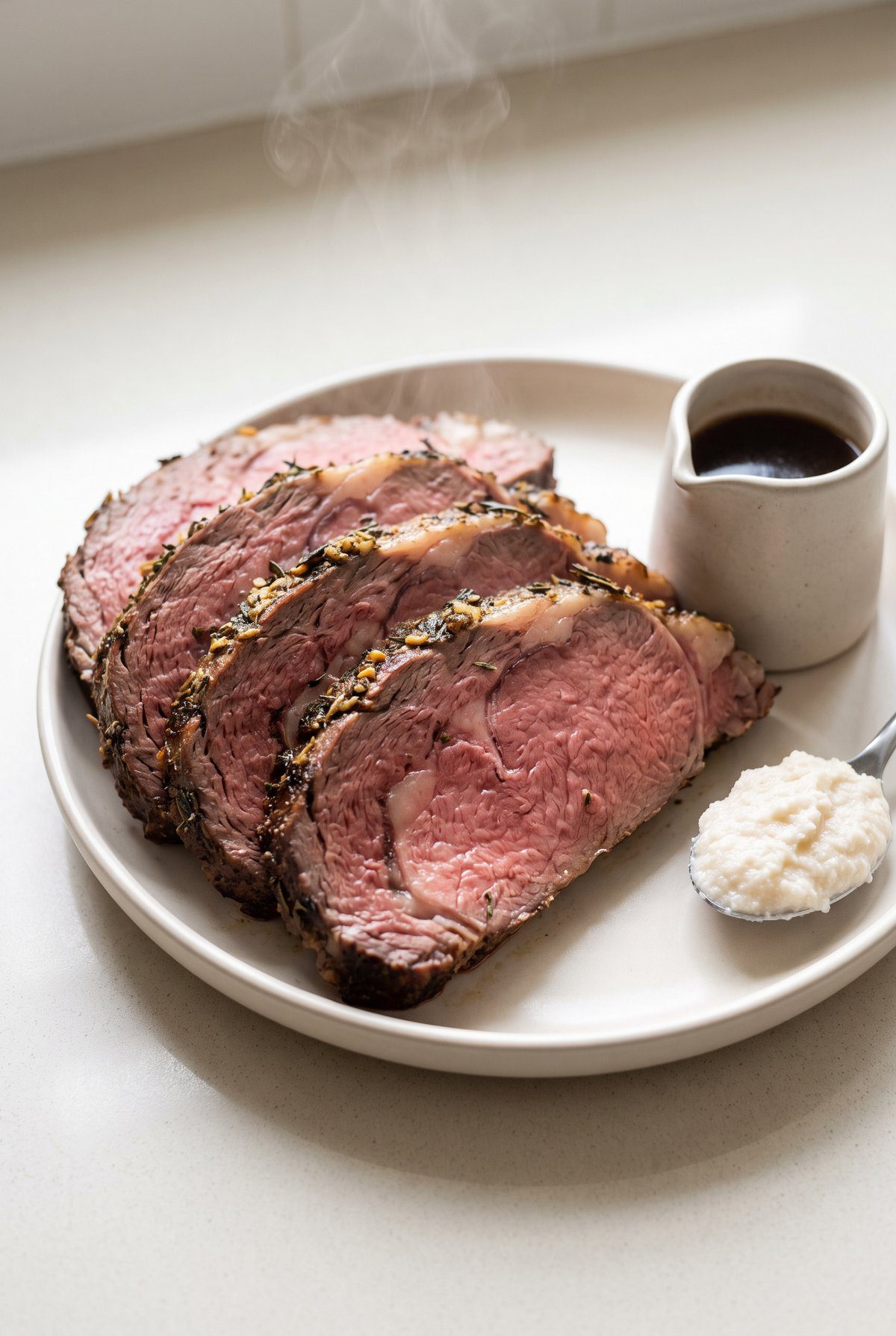
How to Serve Prime Rib
Prime Rib belongs next to creamy mashed potatoes, Yorkshire pudding, and something green like roasted asparagus or garlicky green beans. Horseradish on the side is not optional in most houses, and a spoonful of the au jus over each slice means the meat doesn’t need anything else. Popovers or crusty dinner rolls round out the table, and a wedge salad served first buys you time while the roast rests.
Loved This Recipe?
Prime Rib asks for a thermometer and a 30-minute rest before carving, and it pays both back the second you slice into it.
Leave a star rating in the comments below, it helps other people find this recipe. Made it? Tag @allwellfed on Instagram, I love seeing this one in other people’s kitchens.
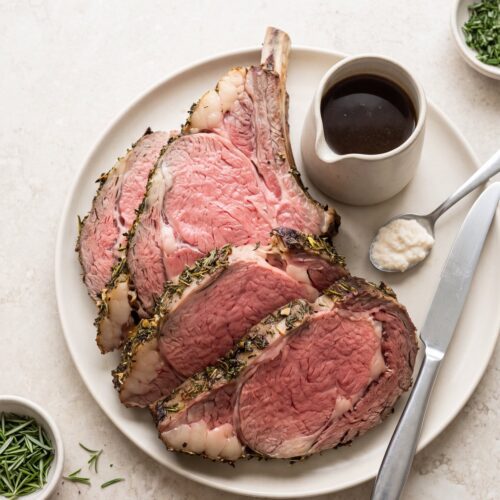
Prime Rib Roast with Garlic Herb Butter
Equipment
- Instant-Read Thermometer 125°F is a narrow window, and a minute past it changes the texture. Worth checking early rather than late.
Ingredients
- 1 (5 lb) bone-in standing rib roast 2 to 3 bones
- 1 tbsp kosher salt
- 2 tsp black pepper
- 1/2 cup unsalted butter 8 tbsp, softened
- 8 cloves garlic minced
- 2 tbsp fresh rosemary chopped
- 1 tbsp fresh thyme leaves chopped
- 1 large yellow onion quartered
- 1 cup dry red wine
- 2 cups beef broth
- prepared horseradish for serving

Instructions
- Salt it early: Pat the roast dry and rub the kosher salt and black pepper over every surface. Set it on a rack over a sheet pan and refrigerate uncovered for at least 4 hours and up to 24. The salt works its way in, and the dry surface browns far better in the oven.
- Let it come to room temperature: Take the roast out of the fridge 2 hours before it goes in the oven. A cold center means the outside overshoots by 20 degrees waiting for the middle to catch up. This stretch is hands-off and isn’t counted in the times on the card.
- Make the garlic herb butter: Mash the softened butter with the garlic, rosemary, and thyme in a small bowl until evenly mixed. Spread it thickly over the top and sides of the roast, right over the fat cap.
- Blast it hot: Heat the oven to 500°F. Scatter the quartered onion in a roasting pan and set the roast on top, bone side down. Roast 15 minutes, until the butter has melted in and the surface is browned.
- Drop the heat and roast to temperature: Lower the oven to 325°F without leaving the door open any longer than you have to. Roast about 13-15 minutes per pound, roughly 65-75 minutes for a 5-pound roast, until an instant-read thermometer in the center of the meat and clear of the bone reads 125°F for medium rare. Start checking at 60 minutes.
- Rest 30 minutes: Move the roast to a cutting board and tent it loosely with foil. It climbs another 5-10 degrees as it sits, landing at 130-135°F for medium rare. USDA guidance for whole cuts of beef is 145°F followed by a 3-minute rest, so pull the roast at 140°F instead if you want to meet that mark. Either way, the 30 minutes are not optional: carve it early and the juice ends up on the board.
- Make the au jus and carve: Set the roasting pan over medium-high heat on the stove, pour in the red wine, and scrape up the browned bits for 3-4 minutes. Add the beef broth and simmer 5-6 minutes until it reduces slightly, then strain into a pitcher. Cut the bones away in one piece, slice the meat across the grain about 1/2 inch thick, and serve with the jus and horseradish.
Notes

If you made this, leave a star rating down in the comments. It takes about ten seconds, and it’s how other cooks decide whether a recipe is worth trying.